
Estimated reading time: 2 minutes
360° Marketing
Marketing only stays coherent when it’s treated as a holistic, always-on system—not a sequence of campaigns. In other words: aligning what the brand promises, what it delivers, and what it can prove (measurement + governance) across every touchpoint. This is consistent with the “holistic marketing” view: marketing performs best when activities are designed as an interconnected whole rather than separated in tactics.
“The Omnibus” (an operating metaphor)
Omnibus is used here as a metaphor for a single operating vehicle: one shared system that carries every marketing decision together—strategy, channels, experience, data, and measurement. In this frame, marketing doesn’t “run campaigns”; it runs a promise. And every touchpoint is accountable to the same proof loop: what’s claimed, what’s delivered, what customers experience, and what the data confirms. The moment each channel optimizes for its own story, the brand splinters. The Omnibus forces coherence—so growth compounds instead of resetting every quarter.
The primary channels in a 360 setup (PESO)
A clean way to structure integrated marketing and communications is the PESO model (Paid, Earned, Shared, Owned).
- Owned: website/editorial, SEO, email/CRM, community, product/UX
- Paid: search, paid social, display/video, affiliates, retail media, OOH
- Earned: PR, reviews, partnerships, press coverage, referrals
- Shared: organic social, creators, communities, UGC
What’s changing now because of AI (and why it raises the bar)
- Content is cheaper; trust is harder. AI increases volume and variation, so differentiation shifts to judgment, evidence, and consistency.
- Discovery is shifting. In AI-assisted search environments, early research suggests meaningful CTR declines for some query sets—putting more pressure on authority and proof, not just output.
- Personalization scales—if governance is real. This requires first-party data discipline, clear consent, and minimization principles (not “collect everything”).
AI limitations a 360 team can’t ignore
- Accuracy risk (hallucinations) + bias → requires risk controls and review systems; NIST’s AI RMF is a strong baseline for organizational AI risk management.
- Regulation: the European Commission notes the EU AI Act entered into force on 1 August 2024 (with phased application).
- IP/copyright: the U.S. Copyright Office provides guidance on registering works that include AI-generated material and the role of human authorship.
References: - Trustworthy AI principles: OECD AI Principles are a widely cited intergovernmental baseline.
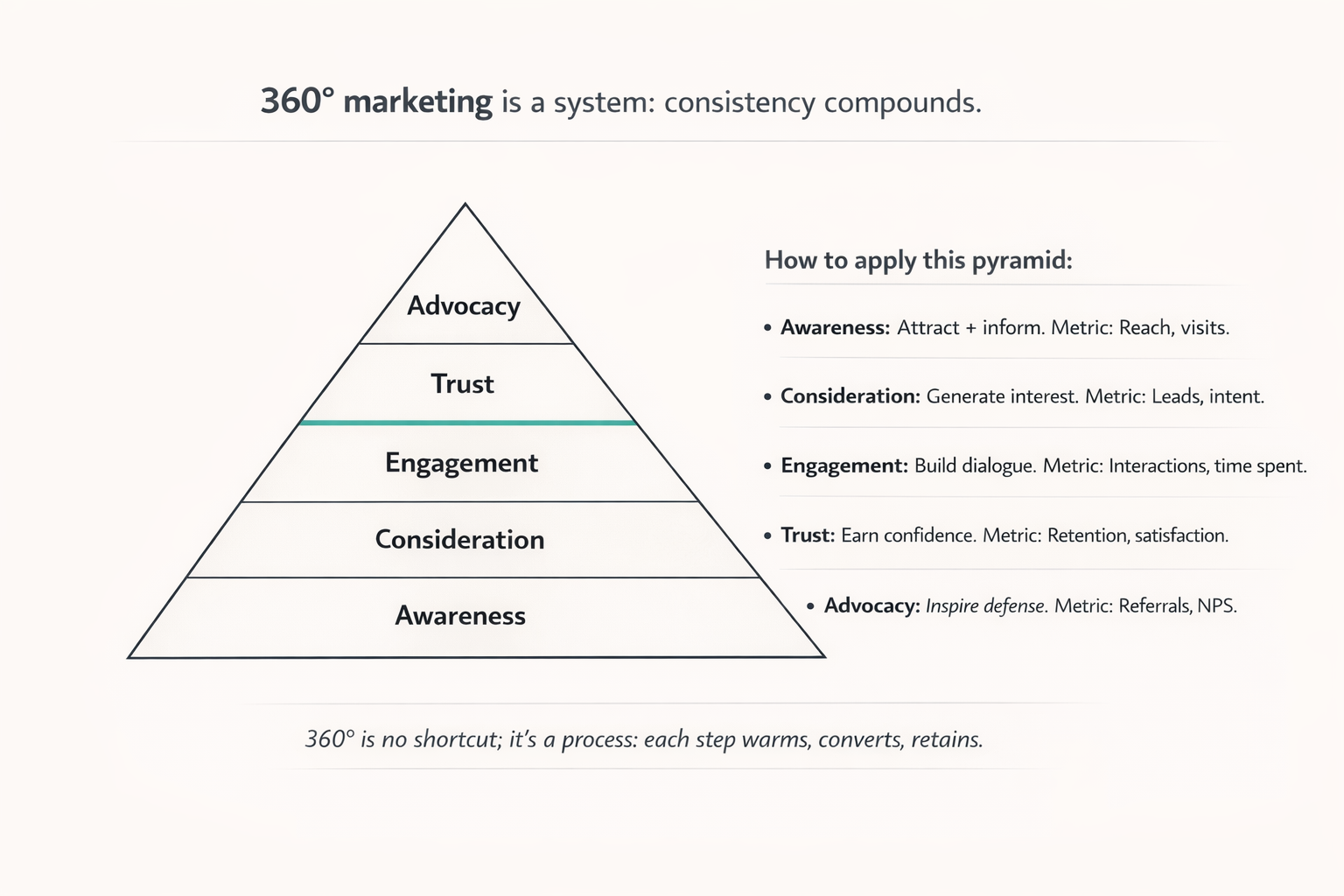
Relationship Building Pyramid (SVG)
Essential questions for a true 360° approach
- What is the single promise the brand can prove in product and experience—not just claim?
- Which customer moments actually move outcomes (trigger → choice → use → retention)?
- What’s the minimum channel set required for coherence (not “everywhere,” but consistent)?
- What data is truly necessary, consented, and governed—and what decisions will it drive?
(GDPR principles: https://gdpr-info.eu/art-5-gdpr/) - Where does AI speed up execution without compromising accuracy, privacy, authorship, or compliance?
(NIST AI RMF: https://www.nist.gov/itl/ai-risk-management-framework) - How will success be measured in two speeds: performance now + trust over time?